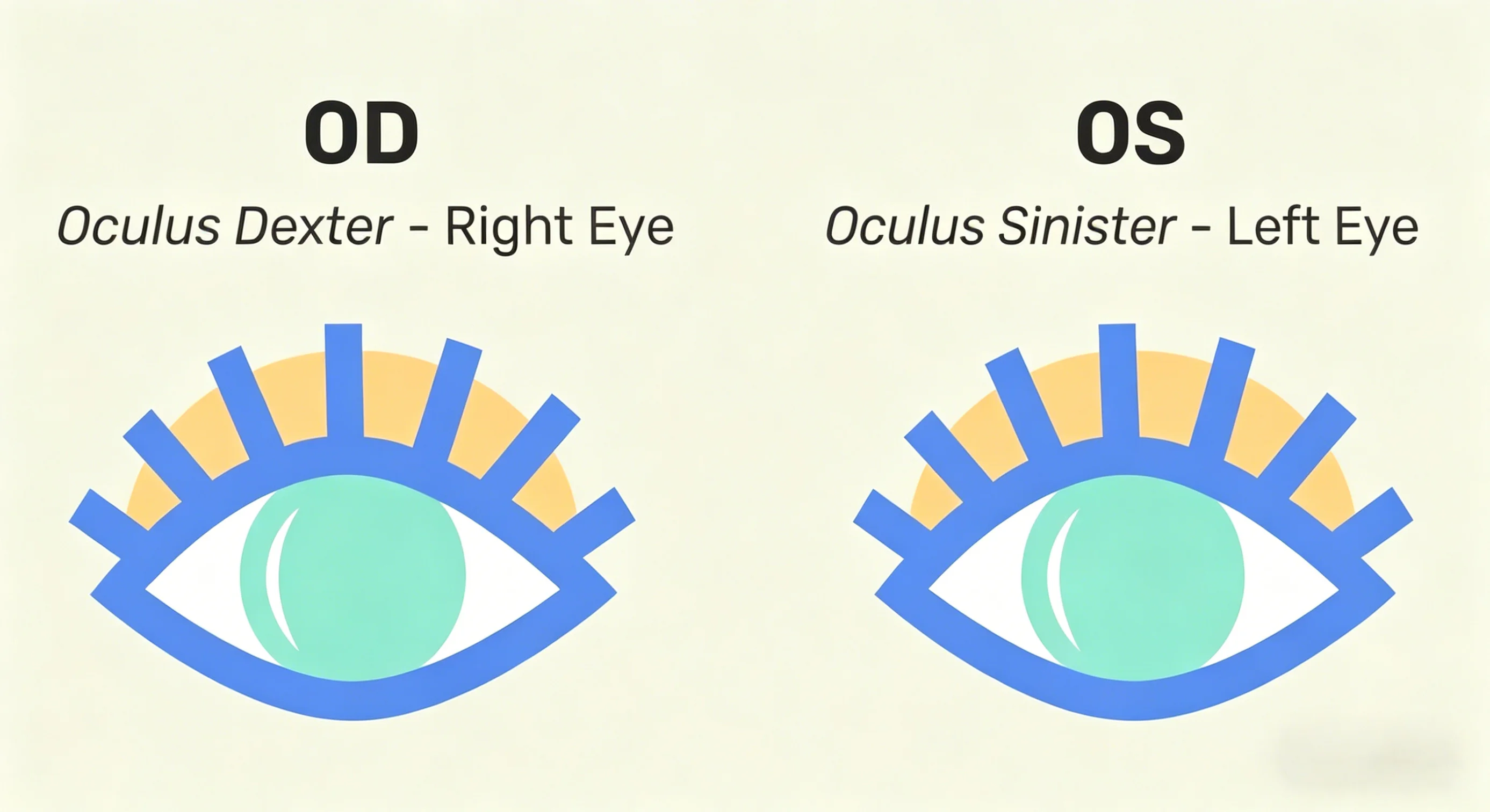
When you receive an eye exam report or a prescription for glasses, the first things that usually catch your eye are the abbreviations OD and OS. Although they may sound like complex medical jargon, their underlying meaning is actually quite simple:
- OD: Derived from the Latin *Oculus Dexter*, referring to your right eye.
- OS: Derived from the Latin *Oculus Sinister*, referring to your left eye.
If you also see "OU" on the form, it stands for "both eyes." Doctors use these abbreviations to ensure that there is no confusion between the left and right eyes when recording refractive errors, astigmatism, or prescribing medications.
Understanding these two basic abbreviations is merely the first step toward deciphering your prescription. The dense rows of plus and minus signs—along with the accompanying numbers—are essentially telling the doctor how your eyes refract light. If you would like to interpret your own vision records with greater ease, or if you are simply curious about the specific meaning behind those figures, the following content will unveil the secrets of eye care prescriptions.
Recommended Reading: How to Read Your Eye Prescription
Common Eyeglass Prescription Abbreviations and Technical Terms
Beyond the basic OD and OS, your prescription slip is often filled with a host of other letters and numbers. Together, these symbols form a visual map of your eyes. To help demystify these terms, we have compiled this easy-to-understand reference guide for you:
1. Core Correction Parameters
SPH (Sphere):
This is the fundamental unit for measuring vision problems. It indicates the lens power required to correct your vision.
- Negative Sign (-): Indicates that you are nearsighted (myopic).
- Positive Sign (+): Indicates that you are farsighted (hyperopic).
If the values include both positive and negative signs, it suggests that you may require comprehensive correction addressing both distance and near vision simultaneously.
CYL (Cylinder):
This value specifically measures astigmatism. If there is a number in this column on your prescription, it means your eye is not perfectly spherical in shape. The higher the number, the more pronounced the astigmatism, requiring a more precise lens to correct it.
Axis:
The axis is expressed in degrees (1–180). If the CYL value represents the *magnitude* of the astigmatism, the Axis represents its *direction*. It instructs the lens technician at what angle the lens should be mounted to accurately align with the specific orientation of your astigmatism.
2. Special Function Indicators
Add (Reading Addition):
Primarily used for correcting presbyopia (age-related farsightedness). It represents the "additional power" added to the lower portion of multifocal lenses (such as progressive lenses) to help you see clearly when reading or viewing near objects.
Prism and Base:
If your eyes do not work together effectively, your prescription may include abbreviations such as BI (Base In), BO (Base Out), BU (Base Up), or BD (Base Down). These abbreviations, combined with specific numerical values, are used to correct eye alignment deviations and prevent double vision or visual fatigue.
3. Fitting and Adaptation Parameters
PD (Pupillary Distance):
This is a crucial measurement in the eyeglass fitting process; it measures the distance between the centers of your left and right pupils. An accurate pupillary distance (PD) ensures that the "optical center" of your lenses aligns directly with your pupils, thereby guaranteeing a comfortable fit.
Helpful Tip: If you cannot find your PD value on your prescription, there is no need to worry. You can measure it yourself using our guide on "How to Measure PD," or you can consult a professional optician to obtain this crucial measurement.
Types of Prescription Lenses
When you receive your prescription slip—which often resembles a chart—you will notice it is typically divided into two main rows, labeled OD (Right Eye) and OS (Left Eye). The column headers located across the top of the chart list the various technical measurements and data points we discussed earlier.
In addition to your specific power requirements, your doctor will also indicate the lens type best suited to your needs. These abbreviations denote the functional design of the lenses; understanding them will help you select the eyewear that offers you the greatest comfort:
Common Lens Function Abbreviations
SV (Single Vision):
Single vision is the most basic type of lens. The entire lens features a single, uniform power—designed exclusively to correct either nearsightedness (myopia) or farsightedness (hyperopia).
BF (Bifocal):
A bifocal lens combines two different powers into a single unit. The upper portion is used for distance vision, while the lower portion is used for near vision (such as reading). You will notice a distinct dividing line on the lens that separates these two visual zones.
TF (Trifocal):
Offering an additional layer of functionality compared to bifocals, the trifocal lens addresses visual needs across three distinct distances: far, intermediate, and near. Similarly, the lens features clear lines that demarcate these three different functional zones.
PL or PAL (Progressive Lenses):
Progressives represent a highly popular, cutting-edge choice in modern eyewear. Like bifocal or trifocal lenses, they allow you to see objects clearly at varying distances; however, their most impressive feature is that the lens surface remains smooth and seamless, completely free of any visible dividing lines. This not only enhances the aesthetic appeal of the glasses but also ensures a much more natural and fluid visual transition.
Contact Lens Prescriptions
If you plan to wear contact lenses, you will notice that your prescription includes several specific parameters unique to this type of eyewear. Unlike standard eyeglasses, contact lenses sit directly on the surface of the eyeball; therefore, a precise match in size and shape is absolutely critical.
The following are two core abbreviations unique to contact lens prescriptions:
BC (Base Curve):
The Base Curve indicates the curvature of the lens. Since every individual's eyeball curvature is unique, a doctor will measure the curvature of your cornea to determine whether the lens needs to be slightly "steeper" or slightly "flatter." An appropriate Base Curve ensures that the lens fits securely and comfortably against the eyeball—neither being too tight (which could restrict oxygen flow) nor too loose (which could cause the lens to shift).
DIA (Diameter):
DIA represents the total width of the lens (typically measured in millimeters). This value determines the extent to which the lens covers the cornea. The correct diameter ensures that the edges of the lens do not rub against the eyelids, while simultaneously providing sufficient coverage to ensure clear vision.
Conclusion
Having broken down the meanings of OD (right eye), OS (left eye), and various professional abbreviations, we trust that the prescription slip—which may have initially appeared complex—now looks clear and straightforward to you. Mastering this foundational knowledge will not only help you better understand your own vision health but also empower you to communicate your eyewear needs with greater confidence.
You are now fully prepared. The crucial next step is to use these precise parameters to select a pair of glasses that are both aesthetically pleasing and comfortable to wear. We hope this guide serves as a valuable companion on your journey toward clear vision, helping you effortlessly embrace a brighter, more vibrant world.


