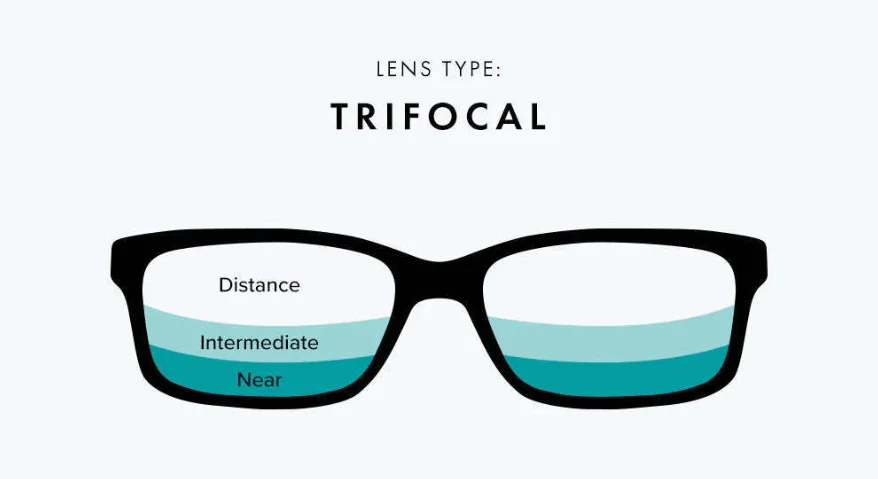
Trifocal lenses integrate three different refractive powers into a single lens, essentially combining distance glasses, office glasses, and reading glasses into one, meeting the needs of multi-distance vision. Different areas use different prescriptions, and the wearer automatically switches to the corresponding visual area by adjusting their gaze, thus achieving clear imaging at various distances.
This article will systematically analyze the optical principles of trifocal glasses and their suitable users, comparing them with bifocal and progressive multifocal glasses to help you make a more rational choice of lens type suitable for your visual needs.
What are Trifocal Glasses?
Trifocal glasses are a type of multifocal lens that needs to be fitted into eyeglass frames. Unlike monofocal lenses, which only have a single power, trifocal glasses integrate three different refractive powers within a single lens to simultaneously correct vision at three different viewing distances. They are primarily suitable for people with blurred vision at distance, intermediate distance, and near distance, especially those with presbyopia (medically known as presbyopia), and can be used in conjunction with other refractive errors such as myopia, hyperopia, or astigmatism for comprehensive correction.
How Trifocal Glasses Work
The lens is divided into three independent optical zones by a visible dividing line, each zone corresponding to a specific viewing distance:
Upper Zone – Distance vision (e.g., driving, viewing scenery); Middle Zone – Intermediate vision (e.g., using a computer, watching television); Lower Zone – Near vision (e.g., reading, checking a mobile phone).
The wearer obtains a clear image at the corresponding distance by changing the direction of their gaze (looking up or down) to enter different optical zones. This design conforms to the natural eye's viewing habits.
Common Trifocal Lens Types
Flat-top Trifocals: The most common type. The near vision zone is usually D-shaped, and the intermediate vision zone is located above the near vision zone. The structure is clear, and it is relatively easy to adapt to.
Franklin-style Trifocals: Different vision zones are horizontally layered, covering the entire width of the lens. This design originates from bifocals, and the optical zones are more clearly defined.
Double-D / Occupational Trifocals: The near vision zone is located both above and below the lens. Suitable for professionals who frequently look up at close objects (such as repair technicians, electricians, etc.).
Bifocal Glasses vs. Trifocal Glasses
Number of Power Zones
Bifocal Lenses: Contain two independent optical zones—the distance vision zone and the near vision zone.
Trifocal Lenses: Add an intermediate vision zone between the distance and near vision zones, used to correct vision needs within approximately arm's length (such as computer use).
Functional Coverage
Bifocal lenses primarily address vision problems at both near and far distances.
Trifocal lenses can simultaneously meet the needs of distance, intermediate, and near vision scenarios, offering a wider range of applications.
Trifocal Lenses vs. Progressive Multifocal Lenses
Difference in Zone Structure
Trifocal Lenses: The three vision zones are clearly defined by visible boundaries, representing a "segmented" optical design.
Progressive Lenses: The power changes continuously without visible boundaries, representing a "continuously gradual" design.
Power Transition Method
Trifocal Lenses: The power change between different vision zones is segmented and abrupt, similar to a "step-like" transition.
Progressive lenses: The prescription changes gradually across the lens surface, creating a smoother, more natural transition, similar to a "slope."
Visual Experience Differences
Trifocal lenses: Switching between visual zones may result in instantaneous image changes, requiring a conscious eye movement to navigate to the corresponding area.
Progressive lenses: The transition is smoother, but some aberrations or distortion may exist in the peripheral areas.
Limitations of Trifocal Lenses
Aesthetics: Trifocal lenses have a clear dividing line, creating distinct visual layers, but they are generally less aesthetically pleasing than progressive glasses without such a dividing line.
Adaptability Issues: Due to the segmented change in prescription, the transitions between visual zones are more abrupt. Some wearers may initially experience a jarring or temporary blurriness, requiring an adaptation period.
Visual Continuity: Compared to progressive lenses, trifocal lenses lack a continuous transition between visual zones, resulting in slightly less visual continuity in certain dynamic eye movement scenarios.
If you suspect you need trifocal or other multifocal vision correction, it is recommended that you schedule a comprehensive eye exam at a professional ophthalmology clinic. Through standardized optometry procedures and binocular vision assessment, an ophthalmologist or optometrist can accurately determine your refractive status, presbyopia, and intermediate-range vision needs, thereby determining whether multifocal contact lenses or trifocal lenses are suitable.
Simultaneously, a professional examination can screen for potential eye health problems, such as dry eye, corneal abnormalities, or other factors that may affect wearing comfort and safety. Ensuring both effective vision correction and good eye health are met before choosing the most suitable lens type and frame design will result in a clearer, more comfortable, and long-term stable visual experience.


