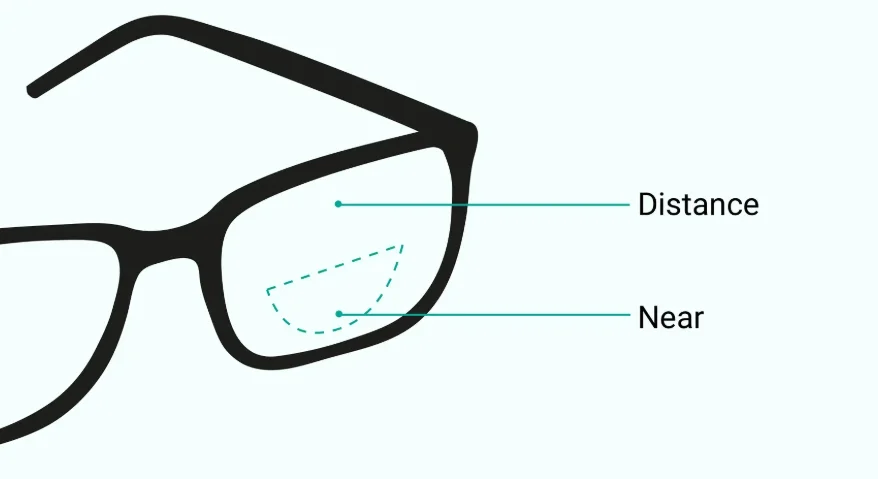
Bifocal lenses are a classic multifocal solution in optometry, designed to simultaneously address the wearer's need to switch between distance vision and near work (such as reading) through a structured design of a single lens. Their core feature is the physical "segmentation of visual fields," a design that was the standard solution for correcting presbyopia before the widespread adoption of digital progressive lenses.
This guide will delve into the construction principles of bifocal lenses, their target population, and their evolution and alternatives in the face of modern optometric technology.
How do bifocal glasses work?
Bifocal glasses physically combine optical correction for distant objects with magnification compensation for near objects. They precisely capture the human behavioral logic of "looking up to see far and looking down to see near," resolving the contradiction that a single-vision lens cannot address simultaneously through spatial division.
Who invented bifocals?
While the exact date of invention is occasionally debated among historians, it is generally accepted that Benjamin Franklin first refined and popularized this design in 1784.
At the time, Franklin was suffering from both nearsightedness and presbyopia, forcing him to frequently change two pairs of glasses for distance vision and reading. To end this inconvenience, he adopted a highly engineering-minded solution:
- Structural Reorganization: He cut the lenses of both pairs of glasses horizontally in half.
- Physical Fusion: He placed the half for distance vision on top and the half for near vision on the bottom, embedding them into the same frame.
This initial design, known as the "Franklin Bifocal," was not only an advancement in optical technology but also an early example of ergonomics.
Types of Bifocal Lenses
With the evolution of industrial manufacturing technology, bifocal lenses have evolved from the original spliced type to one-piece or fused types, and have developed various segment geometries to meet different visual needs:
Executive Type
- Features: Following Franklin's original concept, the near vision zone runs the entire lower half of the lens, bisected by a horizontal straight line.
- Advantages: Provides an extremely wide near field of vision, suitable for professionals who need to review large areas of blueprints or perform precise operations.
Flat-Top
- Features: The near vision zone is presented as a sideways "D" shape or crescent shape, with a straight top and a rounded bottom.
- Advantages: This is currently the most popular style. It effectively reduces the "image jump" sensation when switching between near and far vision, and its appearance is more restrained than the Executive type.
Round Segment
- Features: The near vision segment is a complete circle or oval.
- Advantages: Popular in the early days of glass lenses, although the near field of vision is narrower, its gradual edge transition is relatively soft, and it performs well in certain professions (such as those requiring downward-sloping vision).
Ribbon Segment
- Characteristics: The near field of vision is confined within a narrow rectangular frame, with a portion of the distance field of vision retained at the bottom of the lens.
- Advantages: This special design is primarily used in specific walking environments, allowing the wearer to maintain clarity at a distance while looking down.
From Bifocal to Multifocal
While bifocal lenses laid the foundation for multifocal correction, their distinct "boundary" has always been a drawback in terms of aesthetics and optical continuity. Modern optometry has used this as a cornerstone to evolve progressive multifocal lenses, achieving seamless, full-range coverage from far to near.
If you are currently using single-vision glasses and find yourself needing to remove them or push your phone away when looking at it, this usually means your eyes are experiencing the challenge Franklin faced.
When are bifocal lenses needed?
The primary indication for wearing bifocal lenses stems from a decline or abnormality in the eye's accommodative function. The core value of these lenses lies in their dual-function design, effectively eliminating the inconvenience of frequently switching between different types of glasses. The vast majority of bifocal lens users are over 40 years old. With age, the human lens gradually hardens and loses elasticity, leading to a natural decline in the eye's ability to focus on near objects (i.e., accommodative power). Bifocal lenses, through an upper distance vision zone and a lower near vision zone, simultaneously address the dual needs of clear distance vision and effortless near vision.
In pediatric ophthalmology, bifocal lenses are often used as an adjunct treatment for amblyopia or accommodative esotropia. Through refractive compensation in the lower part of the lens, they can help reduce esotropia caused by excessive accommodation in children, thereby guiding the healthy development of the visual system.
The Evolution of Modern Vision Solutions: Progressive Glasses
While bifocal lenses offer stable performance, their physical characteristics introduce limitations. For example, the prominent horizontal dividing line not only affects aesthetics but can also cause "image jumps" or slight dizziness when switching gaze.
To achieve a more immersive visual experience, progressive multifocal glasses have become the mainstream alternative. Employing a complex digital curved surface design, they eliminate the visible dividing line, achieving a smooth transition across distances, from far and intermediate distances (such as computer screens) to near distances. This not only makes the glasses look identical to ordinary single-vision lenses but also provides a natural visual flow that aligns with the logic of modern life.
Whether you prefer bifocal lenses or modern progressive multifocal lenses, the core goal remains the same: to reshape clear, comfortable, and efficient visual boundaries. Choosing the right lenses is not only a technical process of vision correction but also a deep customization of your personal lifestyle.
When facing the visual transition from single-vision to multifocal lenses, it is recommended to consult a professional optometrist to make the most scientific decision based on your prescription, your eye usage scenarios (such as the intensity of digital office work or the frequency of outdoor sports), and your adaptability. After all, an ideal pair of glasses should not be a burden on life but rather a more acute extension of your perception of the world.


