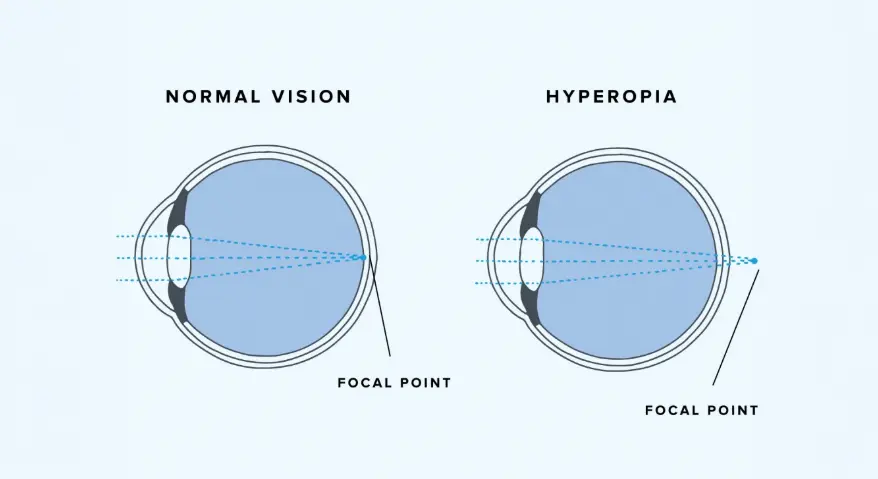
Farsightedness (hyperopia) is a common refractive error that allows people to see distant objects clearly but makes nearby objects appear blurry or difficult to focus on. The symptoms vary depending on the degree of farsightedness: mild cases may cause little to no discomfort, while severe farsightedness often leads to noticeable eye strain and headaches. Most cases stem from congenital eye structure and carry a certain genetic tendency. Fortunately, farsightedness can be effectively corrected—whether with glasses or modern refractive surgery—helping restore clear and comfortable vision.
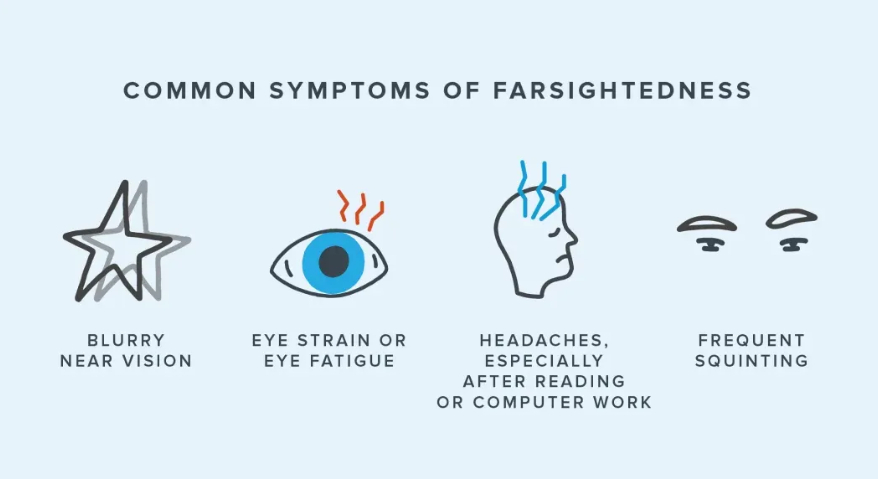
Symptoms of Farsightedness
Typical signs of farsightedness may include:
- Blurry vision when looking at close objects
- Eye fatigue, soreness, or a burning sensation
- Frequent squinting to see clearly
- Headaches after prolonged reading, writing, or computer use
- Impaired depth perception and difficulty judging distances
- In children, behaviors such as rubbing the eyes, avoiding reading, or showing poor concentration during learning tasks
Hyperopia vs. Nearsightedness
Although hyperopia and nearsightedness are often considered complete opposites, they share many similarities: both are refractive errors caused by the eye’s inability to focus light accurately on the retina.
In nearsighted eyes, light is over-refracted, causing the focal point to fall in front of the retina, which makes distant objects appear blurry. In farsighted eyes, by contrast, the focal point falls behind the retina, making it difficult to see nearby objects. In cases of high hyperopia, even distant vision may be affected. Therefore, although farsightedness and nearsightedness are opposite in direction, both are fundamentally caused by abnormal refraction of light.
Hyperopia vs. Presbyopia
Hyperopia and presbyopia can be easily confused because both result in blurry near vision, but their causes are entirely different. Presbyopia occurs as the lens gradually stiffens with age, reducing its ability to accommodate, along with weakening of the surrounding eye muscles, making it difficult to focus on close objects. It primarily affects people over 40 and is the main reason for needing reading glasses. In contrast, hyperopia is largely due to congenital factors or structural abnormalities of the eyeball and is not directly caused by aging.
This comparison helps clarify that, although the symptoms may appear similar, hyperopia and presbyopia differ significantly in their underlying mechanisms, treatment approaches, and affected populations.
What Causes Farsightedness?
The exact cause of farsightedness is not yet fully understood, but research indicates that it is closely related to genetic factors and the structure of the eyeball. If one or both parents are farsighted, their children are more likely to develop the condition. Most infants are born with mild farsightedness, which is a normal physiological phenomenon. As the eyeball gradually grows and elongates, this farsightedness usually diminishes—according to the American Academy of Ophthalmology, only about 4% of children still have farsightedness by the age of one.
From an anatomical perspective, hyperopia typically occurs when the eyeball is relatively short or the cornea is too flat, causing incoming light to focus behind the retina rather than directly on it. This “under-focusing” makes nearby objects appear blurry. In mild farsightedness, young people can often compensate through extra accommodation by the lens and eye muscles, maintaining clear vision. However, in moderate or high farsightedness, the accommodative effort becomes heavy, leading not only to blurred near vision but also headaches, eye strain, and potentially complications such as strabismus (misalignment of the eyes) or amblyopia (commonly known as “lazy eye”).
In essence, hyperopia is a type of refractive error—an imperfection in the eye’s focusing system that prevents light from converging accurately on the retina.
How to Check for Farsightedness
Farsightedness can be diagnosed through a comprehensive, painless eye examination. The check typically includes using eye drops to dilate the pupils, allowing the doctor to get a clearer view of the retina and internal eye structures while assessing overall eye health.
The doctor may have you read an eye chart and use instruments such as a phoropter or retinoscope to adjust lenses and determine the optimal prescription gradually. Hyperopia is usually indicated with a “+” sign (e.g., +2.50).
It is essential to note that standard distance vision tests may not always accurately detect hyperopia, particularly in mild cases of hyperopia in children. Therefore, regular professional eye exams are crucial for early detection and correction of farsightedness, regardless of age.
Hyperopia Treatment
Farsightedness can be effectively corrected, with specific options depending on the degree of farsightedness, age, and lifestyle needs. The main approaches include:
Prescription Eyeglasses
Prescription glasses are the most common and safest correction method. The lenses adjust the focus of light in the eye so it lands accurately on the retina, improving near vision. Depending on the degree of farsightedness, you may need to wear them all day or only for close-up tasks such as reading or working.
Contact Lenses
Contact lenses work on the same principle as glasses but sit directly on the surface of the eye, providing a more natural and convenient wearing experience. They are suitable for daily activities and sports, but require proper hygiene and timely replacement to prevent dry eye or eye infections.
Refractive Surgery
For some patients, surgery is also an option. Procedures such as LASIK or PRK reshape the cornea with a laser to focus light correctly. For high degrees of hyperopia, refractive lens exchange can replace the natural lens with an artificial one to correct vision. Surgical outcomes are usually significant, but costs are higher, and the procedure must be performed by a professional ophthalmologist.
Overall, whether to wear prescription glasses or contact lenses depends on your symptoms and lifestyle. Doctors will recommend the most suitable correction method based on your eye condition, work, and daily activities to help restore clear and comfortable vision.
Complications of Farsightedness
When corrected in time, farsightedness usually does not lead to serious complications. However, in children, untreated farsightedness may cause further vision problems. A common complication in farsighted children is strabismus (eye misalignment), which can occur when the eyes overcompensate to focus. Many children can effectively improve or prevent the development of strabismus by wearing specially designed corrective glasses.
Although hyperopia is less common than nearsightedness, it remains a prevalent refractive issue that can be effectively corrected through various methods. Whether with eyeglasses, contact lenses, or, when necessary, surgery, professional ophthalmologists can provide personalized treatment plans tailored to your needs. Regular eye examinations for early detection and correction are key to maintaining clear and comfortable vision.
At the same time, Elklook can provide prescription glasses for farsightedness—feel free to contact us if you need assistance!
FAQs
Can farsightedness be prevented?
Currently, there is no scientific evidence showing that farsightedness can be prevented. It is mostly related to genetics and the structure of the eyeball, so it cannot be completely avoided through lifestyle changes.
Does farsightedness change over time?
Yes. As people age, farsightedness may gradually worsen, especially when the eye’s ability to accommodate decreases. However, regular eye exams allow doctors to adjust prescriptions in time to ensure that the correction remains appropriate. If vision suddenly declines significantly or new symptoms appear, you should seek medical attention immediately.
What are the main causes of farsightedness?
Farsightedness usually results from a short eyeball length or insufficient corneal curvature, which prevents light from focusing accurately on the retina. It often has a genetic component, meaning children are at higher risk if their parents are farsighted.
Can farsightedness be corrected?
Yes. Common correction methods include glasses and contact lenses, which help the light focus properly. For some patients, refractive surgery may also be considered as a long-term option.
Do you always need glasses for hyperopia?
Whether correction is needed depends on the degree of hyperopia and its symptoms. Mild hyperopia may not require glasses, while moderate to high hyperopia—or cases where eye strain occurs during close-up tasks—are better managed with glasses or contact lenses. Ultimately, the decision should be made by an eye doctor based on examination results.


