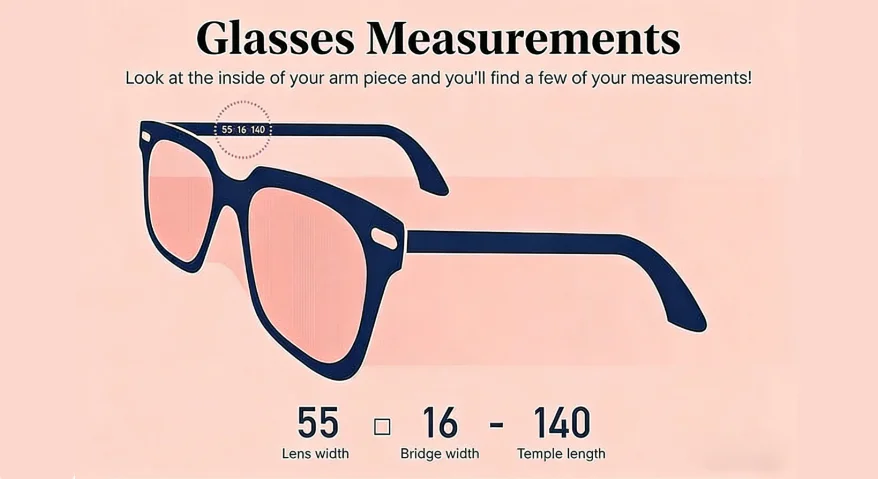
Have you ever wondered what those tiny numbers—tucked away on the inside of the temples—actually represent on the glasses you wear every day? Or perhaps you’ve never even noticed they were there at all.
In reality, these numbers constitute your glasses' sizing guide. Don't let their small appearance fool you; even a minute discrepancy of just a few millimeters can be the deciding factor in whether your glasses pinch your nose, slide down your face, or fit you perfectly. If you want your eyewear to be both comfortable and optimized for your vision, deciphering these "codes" is absolutely essential.
Looking to select a pair of frames that are as stylish as they are comfortable to wear? We'll help you unlock the secrets behind these numbers, guiding you step-by-step on how to measure and choose the glasses size that suits you best—ensuring that finding your perfect pair is no longer a matter of pure luck.
What Do the Numbers on Your Glasses Mean?
When you take a close look at the inside of your glasses' temples (the arms), you will typically find a set of three numbers that serve as an identification code. Much like clothing sizes, these numbers indicate the lens width, bridge width, and temple length. These figures are usually separated by spaces, hyphens, or small squares.
In addition to this core set of dimensions, the temples may also feature other characters representing the model number, color code, or brand name. Identifying the dimensions is quite simple, as they always appear in a fixed sequence and are consistently measured in millimeters (mm). Here is a detailed breakdown of these key measurements:
Lens Width (Width of a Single Lens/Frame Side)
The first measurement in this sequence is the lens width. It represents the horizontal distance across the widest part of a single lens.
Note: This measurement refers solely to the transparent lens area itself and does not include the thickness of the surrounding frame rim. This value determines the extent to which the glasses cover the eye area.
Common Range: 40–60 mm.
Bridge Width
The second number—immediately following the lens width—is the bridge width. Despite its name, this figure actually refers to the shortest distance between the two lenses—specifically, the width of the gap that rests across the nose.
How to Choose: Individuals with a narrower nose bridge should opt for a smaller value, while those with a wider bridge should select a larger value. This ensures the glasses sit securely on the nose bridge without sliding down or pinching the face.
Common Range: 14–24 mm.
Temple Length
The third number represents the total length of the temple arm. It is measured from the screw hinge at the edge of the frame all the way to the curved tip that hooks behind the ear.
Key to Comfort: To ensure a secure fit, the temples must be long enough to curve comfortably around the ears, yet not so long that the tips protrude excessively behind the head. This number typically ends in a 0 or a 5.
Common Range: 120–150 mm.
Other Glasses Dimensions
Beyond the standard trio printed on the temples as described above, there are two additional—often unprinted—measurements that are nonetheless crucial when actually trying on a pair of glasses:
1. Total Frame Width: This refers to the overall horizontal distance across the entire frame, measured from its widest point on the left to its widest point on the right. The principle for selection is simple: the total width of the frame should be proportionate to the width of your face, ensuring that your eyes are positioned at the optical center of the lenses.
Common Range: 125–150 mm.
2. Lens Height: This refers to the vertical measurement of the lens from top to bottom. This dimension is particularly important if you require progressive multifocal lenses, as the lenses need sufficient vertical space to accommodate the various prescription zones.
Common Range: 32–38 mm.
How to Measure Your Glasses Yourself
If the dimensions aren't marked on your favorite pair of glasses—or if the lettering has worn off and become illegible—you can easily retrieve this key data using just a few simple tools. All you need is a ruler or a flexible tape measure marked in millimeters (mm); then, simply follow the steps below to take precise measurements.
How to Measure Lens Width
Position your ruler horizontally and measure the distance across the widest part of a single lens.
Tip: Measure only the transparent lens area; do not include the thickness of the surrounding frame. This is the core value that determines the visual proportions of the glasses.
How to Measure Bridge Width
This step involves measuring the shortest distance between the two lenses—specifically, the gap that rests across the bridge of your nose.
Tip: Locate the two points where the left and right lenses are closest to each other, and measure the horizontal distance between them in millimeters.
How to Measure Temple Length
Since temples (arms) typically feature a curve, you will need to measure them in two segments and then sum the results:
Straight Section: Start measuring from the screw (hinge) where the temple connects to the frame, and measure up to the point where the temple begins to curve downward.
Curved Section: Measure from that bending point to the very tip of the temple.
Final Step: Add these two values together to obtain the total length of your temple.
How to Measure Total Frame Width
This is a crucial indicator for determining how well the glasses fit your face shape. Measure the horizontal distance across the widest part of the front of the glasses.
Tip: Unlike measuring the lens width, this measurement *must* include the outer edges of the frame on both sides, as well as any protruding decorative elements. This ensures you capture the actual amount of space the glasses will occupy on your face.
How to Measure Lens Height
Position your ruler vertically and measure the distance from the very top edge of the lens to its very bottom edge.
Pro Tip: If you plan to wear progressive multifocal lenses, it is recommended that the lens height be at least 30 millimeters. This ensures there is sufficient vertical space to accommodate the various visual zones required for different viewing distances.
How to Choose the Right Glasses Size Based on Your Face Shape
If you don't have a pair of glasses handy to use as a reference, don't worry. By observing your facial features and making a few simple estimates, you can still find that perfect pair of frames. Remember: while measurements serve as a useful guide, the actual comfort and confidence you feel when wearing the glasses are the ultimate deciding factors.
Here are a few practical tips to help you find the perfect match for your face shape:
Understand Your Nose Bridge Structure
Whether your glasses sit securely on your face without slipping depends entirely on how well they fit your nose bridge. Stand in front of a mirror and observe:
Width: If you have a narrow nose bridge, frames with a smaller bridge width will sit more securely; if you have a wider nose bridge, you will need a style with a larger bridge width.
Height/Position: Observe where your nose bridge begins on your face. If your bridge is high (sitting close to your brow line), frames designed for high bridges will look the most natural; if your bridge sits lower, frames with adjustable nose pads or a low bridge fit (often referred to as Asian Fit) will typically be more comfortable.
Measure Your Pupillary Distance (PD)
Pupillary Distance (PD) refers to the distance between the centers of your two pupils. While it doesn't directly determine the overall size of the frames, it dictates where the optical centers of your lenses should be positioned.
The Core Purpose: Ideally, your pupils should sit right in the exact center of the lenses; this ensures the clearest, most effortless vision when looking through the glasses. You can measure your pupillary distance at home and provide it to your optician when purchasing glasses online or in a store.
A Fun Trick: Sizing Up with a Credit Card
This is a widely shared and surprisingly effective "hack." The short edge of a standard credit card measures approximately 54 millimeters, which happens to be a useful reference point for an average lens width.
- Take a standard credit card and hold it vertically against your face (with the short edge pointing upward).
- Align the long edge of the card with the center line of your nose bridge.
- Observe where the other edge of the card falls:
Extends past the outer corner of your eye: This suggests your face shape is best suited for small frames (frames with narrower lenses).
Aligns perfectly with the outer corner of your eye: Medium-sized frames are likely your best choice.
Does not reach the outer corner of your eye: You may be better suited for large frames or frames with wider arms to ensure a balanced visual proportion.
Eyewear Size Reference Guide
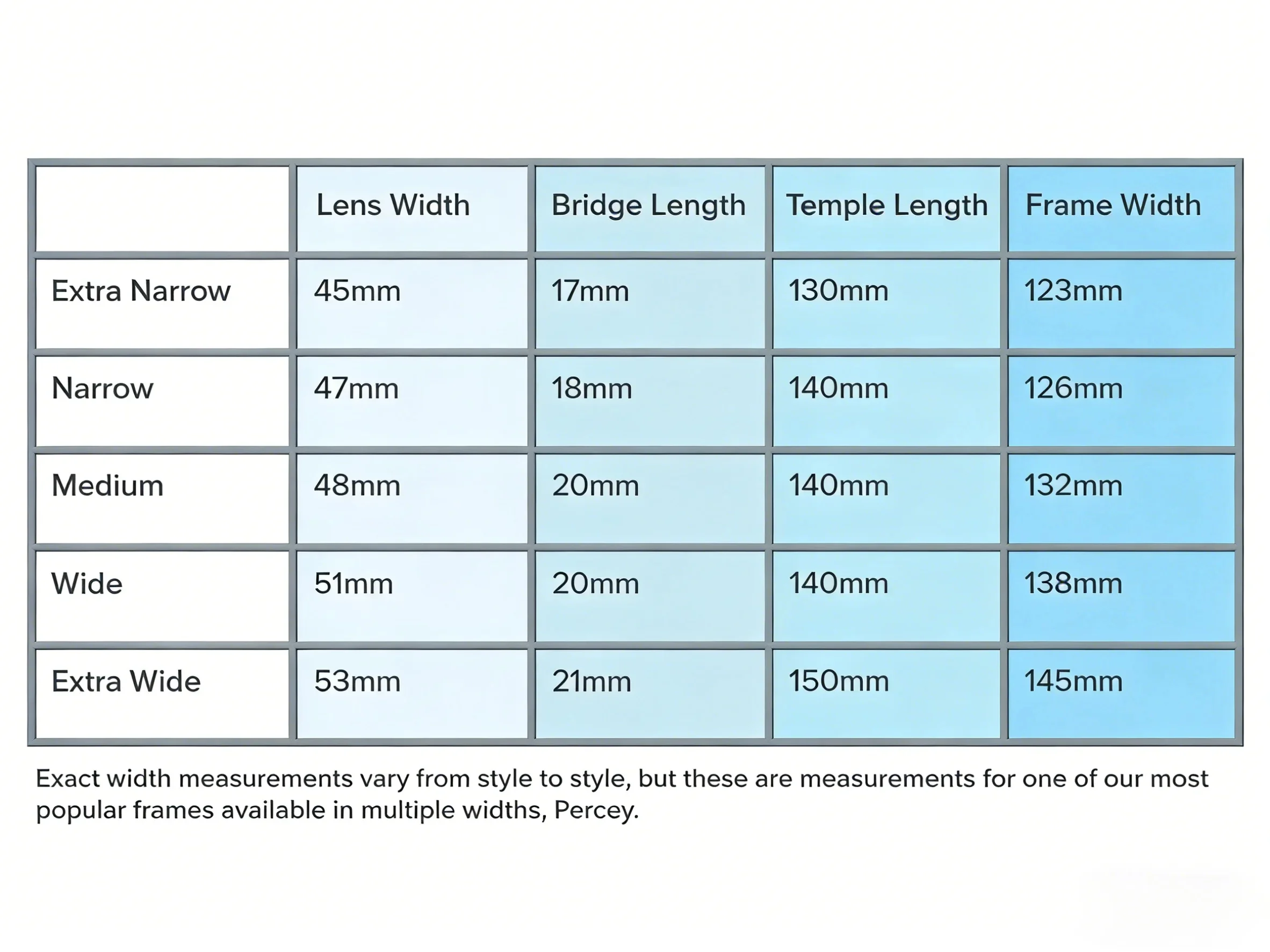
When selecting eyewear, understanding the correlation between numerical measurements and actual fit can help you quickly narrow down the options to find the frames that suit you best.
During the selection process, we typically categorize frame widths into five distinct specifications. Although every individual's face shape is unique, our experience suggests that "Medium" width frames generally serve as a safe choice for most people, striking an optimal balance between comfort and visual proportion.
It is worth noting that even if two pairs of glasses share identical listed dimensions, the actual feel when worn on the face may differ due to variations in materials (e.g., metal versus acetate) or rim thickness. The following serves as a reference guide for common size classifications:
Conclusion
Knowing your precise eyewear measurements is undoubtedly the golden key to unlocking a comfortable and satisfying fitting experience. If you happen to have a pair of old glasses close at hand that fit you perfectly, their specific dimensions will serve as the ideal benchmark for selecting your next favorite frames.
However, please keep in mind that these numerical measurements are not the sole criterion, nor should you feel completely bound by them. Rather, they function as a reliable "guide to avoid pitfalls," helping you quickly narrow down your options amidst a vast sea of frames. While striving for dimensional accuracy, don't hesitate to boldly experiment with different materials and designs—doing so often leads to delightful and unexpected discoveries.


