Whether you have just received a new pair of glasses or your beloved old frames have become a bit loose after years of wear, having your glasses constantly slide down or pinch the bridge of your nose is always a headache. While visiting a professional optician for an adjustment is undoubtedly the most reliable option, life is busy, and you cannot always find the time to make a special trip to the eyewear store.
In fact, by mastering a few simple tricks, you can easily adjust your glasses yourself at home to restore them to their most comfortable fit. This article will introduce several simple, practical methods to help you resolve issues with loose frames, ensuring your vision remains clear and steady.
Step One Before You Start: Get to Know Your "Old Companion"
Before you begin make any adjustments, it is essential to understand the basic anatomy of your glasses. Much like distinguishing between screws and wooden planks before repairing a piece of furniture, familiarizing yourself with the names of the various parts of your frames will give you the confidence you need to proceed.
You can refer to our guide on glasses anatomy. Familiarize yourself with the core components—such as the temples (the arms that rest over your ears), the curved ear hooks at the very ends of those arms, and the nose pads that sit on the bridge of your nose. Once you know exactly where these key points are located, you can accurately pinpoint the source of the problem—allowing you to apply the right fix and quickly restore your frames to a stable, secure fit.
Tightening Glasses Frames with a Screwdriver
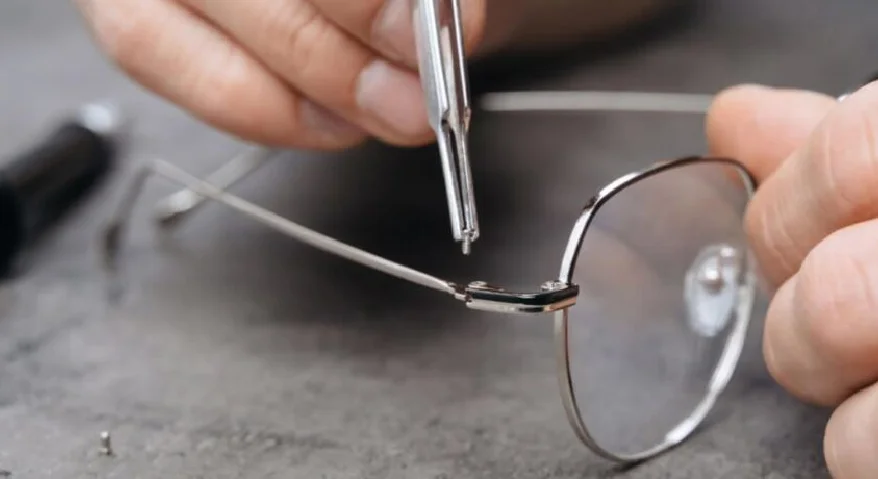
When you notice your glasses frames becoming wobbly, the most immediate place to check is the screws. The vast majority of glasses feature tiny screws at the hinges connecting the temples (arms) to the frame—specifically, at the folding joints.
With daily use involving repeated opening and closing, these screws inevitably tend to loosen over time. It is crucial to develop a habit of checking them regularly; after all, if a screw falls out while you are outdoors, retrieving it can be extremely difficult.
Instructions:
- Prepare Your Tools: You will need a specialized precision screwdriver (typically found in eyeglass repair kits or small hardware sets).
- Tighten the Screws: Align the screwdriver tip with the screw slot and gently turn it in a clockwise direction. Remember to be gentle: stop turning as soon as you feel resistance and confirm that the temple no longer wobbles; do not apply excessive force, as this could strip the threads.
- Safety Tip: If a screw has completely fallen out or if the temple has become fully detached from the frame, it is best to seek assistance from a professional optical shop. In such cases, attempting to force a repair yourself could easily damage the delicate threads.
How to Adjust Acetate Glasses
These frames—characterized by their thick, plastic-like texture—are known as acetate frames. If they become loose after prolonged wear, or if they consistently feel lopsided on your face, it is usually because the material has undergone slight deformation due to heat or pressure.
There is no need to worry; acetate possesses excellent resilience. With a simple heat treatment, you can easily reshape the frames to fit the contours of your face once again.
Preparation
- A bowl of hot water (Note: The water should be hot to the touch but *not* boiling, to avoid burns or damage to the lens coatings).
- A dry towel.
Important Reminder: Throughout this entire process, be sure to protect the lenses; do not allow the lenses to come into contact with the hot water, as high temperatures can damage their specialized surface coatings.
Scenario 1: Fixing Slipping or Pinching Glasses (Adjusting the Temples)
If you feel your glasses are constantly sliding down your nose (too loose), or if they pinch your ears and cause pain (too tight), try adjusting the curvature at the ends of the temples:
- Soften the Material: Submerge the ends of the temples (the parts that hook over your ears) into the hot water for approximately 30 seconds. Upon removal, check the temperature with your fingers first to ensure they are not too hot to handle.
- If too loose: Gently bend the ends of the temples downward and inward with your fingers. This creates a tighter hook, preventing the glasses from sliding down easily.
- If too tight: Gently push the ends upward and outward to flatten them slightly, thereby relieving pressure behind your ears.
- Cool and Set: Place the frames on a flat surface to cool naturally, then try them on. If the fit is still not right, you may repeat the steps above.
Scenario 2: Fixing Crooked Glasses (Adjusting the Hinge Area)
If you notice that your glasses sit unevenly on your face—with one side sitting higher or lower than the other—the angle at the base of the temple (the hinge connection point) may be misaligned:
1. Targeted Heating: Look into a mirror to identify which side is sitting too high, and focus on that side. Submerge the corner of the frame where the temple connects (taking care to avoid the lens) into the hot water for 30 seconds.
2. Fine-Tuning the Angle: Hold the center of the frame steady, and use your other hand to gently adjust the temple:
- Temple sits too high: Gently bend the base of the temple upward.
- Temple sits too low: Gently press the base of the temple downward.
3. Balance Check: Once cooled, put the glasses on and observe them in a mirror. Sometimes, glasses may appear level when resting on a table, yet sit perfectly straight only when worn on the face; this is entirely normal, as everyone's ears differ slightly in height.
How To Adjust Metal Glasses
Compared to plastic frames, metal frames are typically thinner and feature a pair of flexible nose pads. This makes adjustments more straightforward, though it also requires a bit more care and precision on your part.
1. Adjusting the Nose Pads: Solving Slippage and Pressure Marks
The nose pads are the key factor determining the height and stability of your glasses. If your glasses constantly slide down your nose, or if they leave deep red marks on your bridge, try adjusting them as follows:
- Preparation: Firmly grasp the bridge of the glasses (the center section) with one hand, holding the lenses facing outward and the temples pointing toward you.
- If the glasses are too loose or sit too low: Use the thumb and index finger of your other hand to pinch the nose pads, gently pushing them inward (toward the center). This allows the pads to grip the bridge of your nose more snugly.
- If the glasses are too tight or sit too high: Gently push the nose pads outward (away from the center, toward the lenses) slightly. This increases the width at the bridge, allowing the glasses to settle naturally to a lower position.
Expert Tip: Try to keep the angles of both nose pads symmetrical; make only tiny adjustments at a time, and repeatedly try on the glasses until they feel comfortable.
2. Adjusting the Metal Temples
Metal temples typically possess a certain degree of flexibility; in most cases, they can be adjusted directly without the need for heating.
- Adjustment Technique: Use one hand to support the temple arm at the base of the bend (near the hinge), while using your other hand to gently grasp the tip of the temple arm.
- To Tighten (Prevent Slippage): Gently bend the tip of the temple arm downward to increase its grip behind your ear.
- To Loosen (Relieve Pressure): Gently push the tip of the temple arm upward to reduce the pressure felt against your ear.
Important Safety Warning
Although metal is malleable, not all metal frames can be bent indiscriminately:
- Sense the Resistance: If you feel a distinct stiffness or encounter significant resistance while making adjustments, stop immediately. Some metal alloys are extremely hard, and forcing them to bend may result in the temple arm snapping.
- Professional Assistance: If you are unsure about the flexibility of your frames or if you are concerned about damaging expensive surface coatings, seeking assistance from a professional optician is always the safest option.
Certain types of eyewear, such as semi-rimless glasses, are more difficult to adjust than others and are also more prone to damage. During the adjustment process, you run the risk of scratching, damaging, or even breaking the lenses or frames.
Do your glasses feel more secure now that you’ve made these adjustments? If you have any other comfort concerns, please don't hesitate to let us know; we will do our best to assist you. However, if your glasses continue to cause you discomfort, it is best to consult an optometrist. Many optometrists will adjust your glasses for free!


