
As we age, our eyes gradually lose their ability to adjust focus, making it increasingly difficult to see clearly up close. Many people find that they need reading glasses for activities such as reading a book or using a smartphone, but must switch back to their regular prescription glasses for daily tasks. This constant switching can be inconvenient. Progressive lenses are specifically designed to address this issue. They are not suitable for everyone. Understanding the features of progressive lenses, who they are best for, and how they differ from traditional reading glasses can help you find the option that best meets your needs.
What Are Progressive Glasses?
Progressive glasses are advanced multifocal lenses that resemble regular prescription glasses in appearance, but feature a sophisticated optical design on the inside. Unlike traditional bifocal or trifocal lenses with visible dividing lines, progressive lenses use a “progressive” power transition to seamlessly integrate distance, intermediate, and near vision correction into a single lens. This allows wearers to handle tasks such as reading, computer work, and distance viewing with just one pair of glasses, eliminating the inconvenience of frequently switching between different lenses.
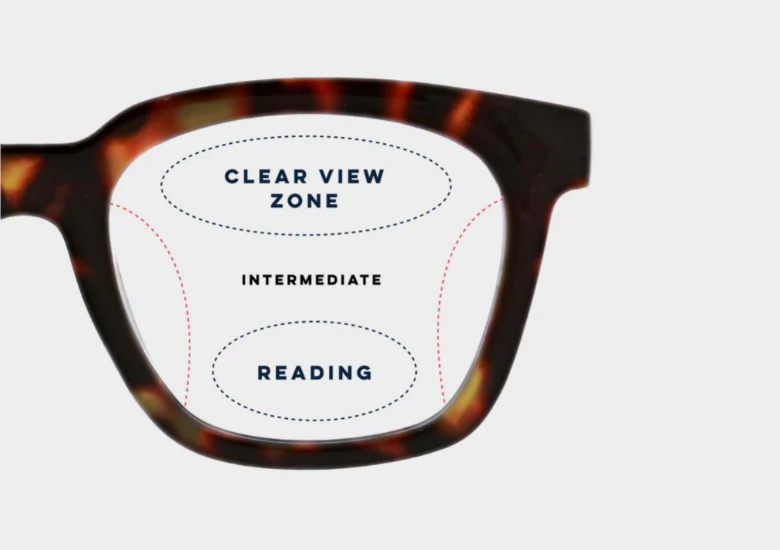
Because the power transition is smooth, progressive lenses provide a more natural and comfortable visual experience without abrupt boundaries. They are sometimes called “no-line bifocals” or “multifocal lenses,” and are internationally abbreviated as PAL (Progressive Addition Lenses). In terms of design, they are generally divided into two types: hard design, which emphasizes distance vision and suits people who spend more time focusing far away; and soft design, which provides a wider intermediate zone, making it ideal for long hours of computer use or tasks performed at arm’s length. With modern advancements, many progressive lenses now adopt hybrid designs to better meet diverse lifestyle needs.
This clever blend of engineering and optics makes progressive glasses an ideal choice for many middle-aged and older adults seeking greater visual comfort.
How Do Progressive Glasses Work?
The working principle of progressive glasses lies in their unique “gradual” optical design, which seamlessly integrates distance, intermediate, and near prescriptions within a single lens. Wearers can naturally shift their gaze to switch to the desired focal distance.
Upper portion of the lens: Primarily for distance vision, ideal for driving or looking at faraway objects.
Middle portion: Designed for intermediate vision, such as using a computer or interacting with others.
Lower portion: Provides clear near vision, convenient for reading, writing, or performing detailed tasks.
Progressive Lenses vs. Single-Vision Lenses
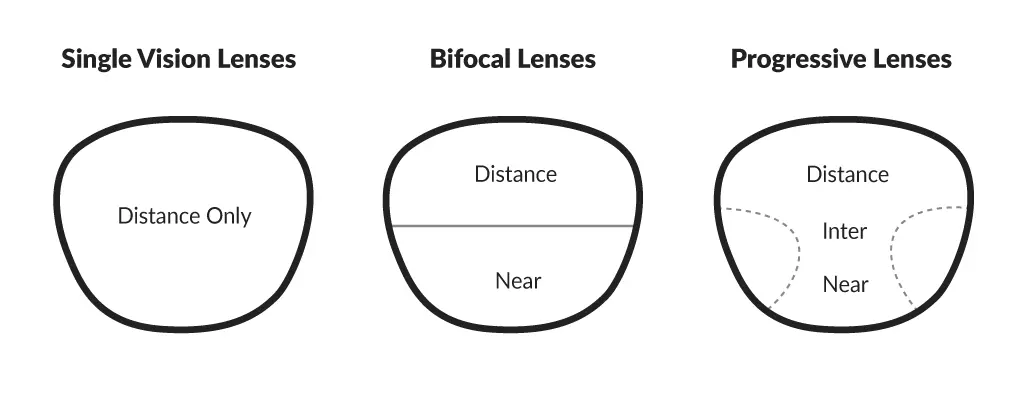
Single-vision lenses have only one prescription and are suitable for correcting vision at a single distance, whereas progressive lenses smoothly integrate multiple prescriptions within a single lens. This allows you to see clearly at different distances without changing glasses. If you currently wear single-vision lenses, your prescription can also be adapted into progressive lenses, providing clear vision for near, intermediate, and distance tasks.
Progressive Lenses vs. Bifocal and Trifocal Lenses
The key advantage of progressive lenses over bifocal or trifocal lenses is their seamless transition. Bifocal lenses typically have a half-moon-shaped near-vision segment at the bottom, while trifocal lenses divide the lens into distinct zones for distance, intermediate, and near vision. These visible lines can create abrupt visual changes and may blur intermediate vision. Progressive lenses eliminate these boundaries, offering a wider, continuous range of prescriptions that allow wearers to naturally focus at far, intermediate, and near distances. This provides a more comfortable and fluid visual experience, truly achieving “one lens for multiple vision needs.”
Who Should Wear Progressive Glasses?
Progressive glasses are suitable for a wide range of vision needs, especially for those who require correction for distance, intermediate, and near vision simultaneously. The most common wearers are middle-aged and older adults experiencing presbyopia—as we age, the lens of the eye gradually thickens and loses its ability to adjust, making near vision blurry and requiring extra help for reading or detailed tasks. In fact, more than half of adults begin to experience this around age 40, making progressive glasses an ideal solution for improving everyday visual comfort.
Beyond presbyopia patients, progressive glasses are also suitable for others with multifocal vision needs, such as teenagers with eye focusing issues, digital device users who spend long hours on screens, drivers who need clear vision both day and night, and professionals with high visual precision requirements, such as pilots or electricians. The flexible design of progressive glasses can be customized to individual needs, providing clear and comfortable vision at different distances and in various situations.
Progressive Lenses: Advantages and Disadvantages
Progressive lenses are popular for their multifocal design, but there are some factors to consider.
Advantages of Progressive Lenses
Multifocal functionality – one pair for multiple needs
Progressive lenses correct distance, intermediate, and near vision simultaneously, allowing wearers to complete daily tasks like reading, computer work, or driving without frequently switching glasses, greatly enhancing convenience.
Seamless power transition – more natural vision
Compared to bifocal or trifocal lenses, progressive lenses eliminate visible lines between prescriptions, avoiding the “image jump” effect and providing a smooth, continuous visual experience. They also look more natural and aesthetically pleasing.
Improved posture and comfort
The smooth power transition helps maintain a natural posture and reduces neck strain caused by frequent shifts in gaze. For long hours of computer use, it can also help alleviate symptoms of digital eye strain.
Aesthetic and customizable
Progressive lenses look almost identical to standard single-vision lenses and can be paired with various frame styles, allowing wearers to maintain a youthful, stylish appearance without exposing lens lines.
Disadvantages of Progressive Lenses
Adaptation period
First-time wearers may need time to learn how to focus through different areas of the lens. During this period, mild dizziness or peripheral blur may occur, but most people adjust within a few days to two weeks.
Peripheral distortion
While the central area is clear, the edges of the lens may appear slightly distorted or blurry at certain angles. This is an inherent feature of the design, but can be minimized with proper lens selection and wearing techniques.
Higher initial cost
Progressive lenses are more complex to manufacture and typically cost more than single-vision or bifocal lenses. However, since they can replace multiple pairs of glasses, they offer excellent long-term value.
Try Progressive Lenses for Comfortable Vision
Experience the comfort of progressive lenses. Whether you’re working at a computer, reading during leisure time, or enjoying outdoor activities, high-quality progressive lenses help you effortlessly handle vision at different distances, making your daily life smoother and more enjoyable. By understanding your vision needs and choosing the right lenses, you can achieve not only clear sight but also a natural and comfortable wearing experience.
Elklook offers a wide selection of stylish frames and a variety of colors, so you can find glasses that are both attractive and practical, no matter your personal style. We also provide convenient return services and online try-on tools, making it easy to find the perfect pair. Now is the ideal time to explore Elklook’s curated collection of progressive and prescription glasses—enhance your vision comfort, enjoy greater freedom in daily life, and showcase your unique style.


