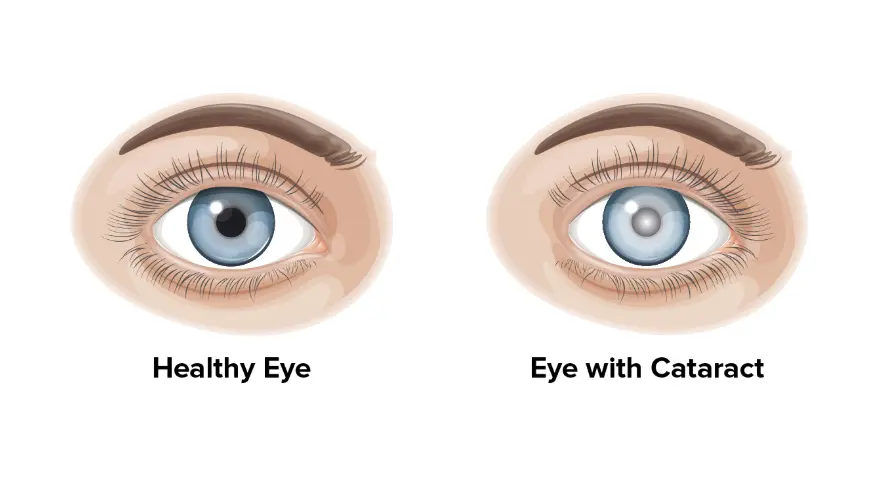
Cataracts are caused by clouding of the lens, resulting from a loss of its original transparency. They can affect one or both eyes. This clouding prevents light from entering the eye normally, leading to blurred vision and dull colors. Patients often describe it as "seeing things through a fog." As the condition progresses, everyday tasks such as reading, driving, or recognizing faces become increasingly difficult, although the disease generally does not cause pain or significant discomfort.
In the following sections, we will systematically introduce the main types of cataracts, which populations are more susceptible, the common mechanisms of their formation, early symptoms, and currently accepted clinical treatment strategies.
What are the causes of cataracts?
The core cause of cataracts is the denaturation and aggregation of proteins within the lens over time, ultimately leading to a decrease in lens transparency. To understand how cataracts affect vision, it's necessary to first understand the role of the lens in the visual system.
The lens is located behind the iris and, along with the cornea, is responsible for refracting light entering the eye and focusing it precisely on the retina. The retina then converts the light signals into electrical signals, which are transmitted to the brain via the optic nerve, ultimately forming a clear visual image.
When the structural proteins within the lens begin to degenerate, aggregate, or become disorganized, its normally transparent tissue gradually becomes cloudy. These cloudy areas block or scatter light, preventing it from focusing properly on the retina. The result is a decrease in visual clarity, manifesting as blurred vision, reduced contrast, or darkened colors—typical symptoms of cataracts.
In short, cataracts are essentially a loss of lens transparency, leading to impaired vision due to obstruction of the light transmission pathway.
Risk Factors for Cataracts
Cataracts have multiple contributing factors, with age being the most significant risk factor, although they are not exclusive to the elderly. Numerous studies have shown that the following factors can increase the likelihood of developing cataracts:
1. Age-Related Factors
As we age, the protein structure of the lens gradually degenerates, making age-related cataracts extremely common in middle-aged and older adults. Cataract formation usually begins after age 40, but most patients experience significant vision loss at age 60 and beyond.
2. Genetic Influence
Family history and specific gene mutations can significantly increase the risk of developing cataracts. Some infants are born with lens opacity, known as congenital cataracts, which are often related to genetic factors or embryonic developmental abnormalities.
3. Environmental and Lifestyle Factors
Long-term exposure to strong ultraviolet radiation (such as in high-altitude areas), air pollution, certain chemicals, and pesticides can accelerate lens opacity. In addition, smoking and heavy alcohol consumption have been shown to increase the incidence of cataracts.
4. Medical and Medication Factors
Certain diseases and treatments also increase the risk, such as diabetes, post-glaucoma surgery, long-term use of corticosteroids, and eye diseases such as uveitis or retinitis pigmentosa.
Main Types of Cataracts
The classification of cataracts is often related to the location and mechanism of lens opacity. Common types include:
- Nuclear Cataract: Occurs in the central region of the lens, usually age-related, and often manifests as progressive blurred vision and increased nearsightedness.
- Cortical Cataract: Opacity begins in the outer cortex of the lens and spreads radially towards the center, often leading to glare and decreased contrast sensitivity.
- Posterior Subcapsular Cataract: Located under the posterior capsule of the lens, it progresses rapidly and often affects near vision and vision in bright light.
Other descriptive types include:
- Age-related cataracts: The most common type, occurring with natural aging.
- Childhood cataracts: Including congenital cataracts and lens opacity occurring in childhood, which are relatively rare but require early treatment. Traumatic Cataract: Caused by blunt trauma or penetrating injury to the eye.
- Secondary Cataract: Often seen after cataract surgery due to lens capsule opacity, and also associated with certain diseases.
Typical Symptoms of Cataracts
Cataracts may be difficult to detect in the early stages, but as the lens opacity worsens, patients may experience the following visual changes:
- Persistent blurred or hazy vision
- Decreased color saturation and dimmer vision
- Distorted vision or double vision
- Significantly reduced night vision
- Increased sensitivity to bright light or sunlight
- Glare or halos around light sources
- Need for stronger light for reading or detailed work
- Frequent changes in eyeglass prescription, especially a gradual increase in nearsightedness
- Children may exhibit a white or grayish-white reflection in the pupil
Cataract Diagnosis
Cataract assessment is typically completed during a systematic and comprehensive eye examination. The doctor will first inquire about your overall health, eye history, and any recent symptoms such as blurred vision, increased glare, or changes in color perception. Subsequently, most patients will undergo a dilated eye exam to allow the doctor to more clearly observe the lens and fundus structures.
During the clinical examination, ophthalmologists often use a slit-lamp microscope to perform high-magnification examinations of the cornea, iris, and lens to confirm the presence and extent of lens opacity. If necessary, a fundus examination (including using an ophthalmoscope to observe the retina and optic nerve) will also be performed to rule out other eye diseases that may affect vision.
Cataract Treatment Options
Treatment options depend on the stage of cataract progression and its impact on daily life. If the opacity is mild, the doctor may suggest improving visual quality by changing eyeglass prescriptions or wearing appropriate contact lenses. However, when cataracts affect reading, night driving, or daily activities, surgery becomes the most effective and long-lasting treatment.
Cataract Surgery: Effectiveness and Safety
Cataract surgery is widely considered one of the safest and most successful ophthalmic surgeries in modern medicine. The procedure is usually short, involving the removal of the cloudy natural lens and the implantation of a clear artificial intraocular lens (IOL) to restore normal light focusing.
Modern IOLs not only restore clear vision, but some types of IOLs can also simultaneously correct refractive errors such as nearsightedness, farsightedness, astigmatism, and presbyopia, helping patients reduce their dependence on glasses.
Some patients may experience posterior capsule opacification after surgery, also known as "secondary cataract." This condition, unlike the initial cataract, can be easily treated with YAG laser treatment, which is usually quick and painless.
Cataract Prevention and Risk Management
Although there is currently no definitive way to completely prevent cataracts, scientific evidence suggests that the following measures can help reduce the risk or slow their progression:
- Regular professional eye examinations, especially in middle and older age, to detect abnormalities early.
- Avoid smoking to reduce oxidative stress damage to the lens. Effectively manage chronic diseases, especially conditions like diabetes that can accelerate cataract formation.
- Maintain a balanced diet and consume foods rich in antioxidants.
- Limit alcohol intake to reduce potential damage to eye tissues.
- Wear sunglasses with UVA/UVB protection outdoors to reduce ultraviolet light exposure.
Although cataracts are irreversible, modern medicine can safely and effectively restore clear vision through precise surgery. If you experience symptoms such as blurred vision, increased glare, or decreased night vision, it is recommended to undergo an eye examination promptly to receive a professional assessment and the most appropriate treatment plan.


