Do you experience discomfort from thick, heavy lenses that press on your nose bridge, requiring frequent adjustments to maintain comfort? If these problems have been bothering you for a long time, then high-refractive-index lenses are worth serious consideration. This article will professionally analyze the core advantages and technical principles of high-refractive-index lenses, helping you determine if they are suitable for your vision needs.
From a basic concept perspective, high-refractive-index lenses are made from high-refractive-index optical resin. Compared to ordinary lenses, they have a stronger ability to bend light. This means that under the same prescription, thinner lenses can be used to achieve the same or even more precise vision correction. Because of this, high-refractive-index lenses excel in reducing overall weight, improving wearing comfort, and enhancing aesthetic appearance, making them a widely recommended professional choice for moderate to high prescriptions.
The Core Advantages of High Refractive Index Lenses
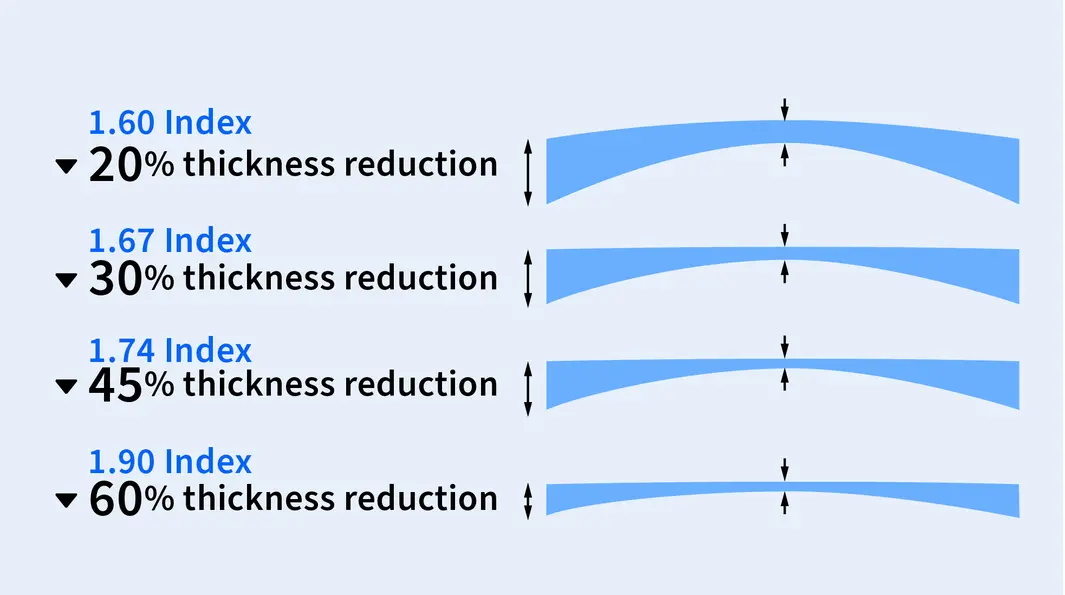
High refractive index lenses are widely used in modern eyewear due to their superior performance. Firstly, in terms of wearing experience, high refractive index materials significantly reduce lens thickness and weight at the same prescription level, making them particularly suitable for people with moderate to high prescriptions. Lighter and thinner lenses effectively reduce pressure on the bridge of the nose and ears, minimizing discomfort from prolonged wear and improving overall comfort.
In terms of appearance, high refractive index lenses offer distinct advantages. Thinner lens edges make the frame lines appear more streamlined and natural, reducing the "heavy" look and visual prominence. This makes the glasses appear more balanced on the face, meeting both daily wearing needs and aesthetic and professional image requirements.
From a visual quality perspective, high refractive index lenses have stronger light refraction capabilities, allowing for precise refractive correction within a smaller lens volume. This feature is especially important for people with high myopia, providing clear, stable, and accurate imaging while maintaining thin and lightweight lenses. They are an ideal lens choice that combines functionality and comfort.
The Core Advantages of High Refractive Index Lenses
High refractive index lenses are widely used in modern eyewear due to their superior performance. Firstly, in terms of wearing experience, high refractive index materials significantly reduce lens thickness and weight at the same prescription level, making them particularly suitable for people with moderate to high prescriptions. Lighter and thinner lenses effectively reduce pressure on the bridge of the nose and ears, minimizing discomfort from prolonged wear and improving overall comfort.
In terms of appearance, high refractive index lenses offer distinct advantages. Thinner lens edges make the frame lines appear more streamlined and natural, reducing the "heavy" look and visual prominence. This makes the glasses appear more balanced on the face, meeting both daily wearing needs and aesthetic and professional image requirements.
From a visual quality perspective, high refractive index lenses have stronger light refraction capabilities, allowing for precise refractive correction within a smaller lens volume. This feature is especially important for people with high myopia, providing clear, stable, and accurate imaging while maintaining thin and lightweight lenses. They are an ideal lens choice that combines functionality and comfort.
How to Choose the Right High-Refractive Index Lenses for You
When choosing high-refractive index lenses, a rational assessment from multiple perspectives is essential. The most crucial factors are your refractive error and the desired lens thickness. Generally, the higher the degree of nearsightedness or astigmatism, the greater the need for thinner lenses. Choosing higher refractive index lenses allows for effective control of lens edge thickness while ensuring accurate vision correction, thus improving wearing comfort and appearance.
Furthermore, price and budget are equally important considerations. Due to the higher demands on materials and manufacturing processes, high-refractive index lenses typically cost more than standard lenses. However, from a long-term wearing perspective, high-refractive index lenses offer significant advantages in terms of reduced weight, improved comfort, and enhanced overall visual performance, often making them a worthwhile investment. It is recommended to consult with a professional optometrist or a reputable eyewear brand to make a comprehensive choice based on your individual vision needs, frame style, and budget, to find the best solution that balances functionality, comfort, and cost-effectiveness.
Dispelling Common Misconceptions About High-Refractive-Index Lenses
Several misconceptions still exist in the market regarding high-refractive-index lenses, and it's necessary to clarify them. Firstly, there's a belief that high-refractive-index lenses are less durable because they are thinner. In reality, modern high-refractive-index lenses utilize advanced optical resin materials and standardized manufacturing processes. Their wear resistance and structural stability meet industry standards, and they are just as reliable as regular lenses under normal use and care conditions.
Secondly, some mistakenly believe that high-refractive-index lenses cannot be coated with anti-reflective or other functional coatings. In fact, high-refractive-index lenses can be coated, and in actual prescription fitting, it's often recommended to use an anti-reflective coating to reduce surface reflections, improve light transmission, and further enhance visual clarity and eye comfort.
Furthermore, the design flexibility of high-refractive-index lenses is often underestimated. They are suitable for various lens types, including single-vision, progressive multifocal, and bifocal lenses, meeting the needs of different age groups, vision requirements, and lifestyles. Therefore, high-refractive-index lenses are not a "limited" option, but rather a mature solution that combines performance, comfort, and versatility.
Daily Care and Maintenance of High Refractive Index Lenses
Proper care is crucial for maintaining the stable performance and extending the lifespan of high refractive index lenses. For daily cleaning, it is recommended to use a specialized lens cleaning solution with a microfiber cleaning cloth to gently remove dust, oil stains, and fingerprints from the lens surface. This prevents small particles from scratching the lenses during cleaning. Avoid using cleaning agents containing harsh chemicals such as alcohol or ammonia, or rough materials like paper towels or clothing corners, as these can damage the lens coating.
When not wearing your glasses, store them properly in a sturdy glasses case to reduce the risk of scratches, crushing, or dropping. Also, develop the habit of handling your glasses with clean hands to minimize the accumulation of oil and dirt on the lenses. Through proper cleaning and storage, high refractive index lenses can maintain clear vision and a comfortable wearing experience for a long time.
Overall, high-refractive-index lenses offer significant advantages in modern eyewear, optimizing the wearing experience in many ways. Whether it's reducing lens weight, improving wearing comfort, enhancing appearance, or achieving precise refractive correction, high-refractive-index lenses provide an efficient and reliable solution for people with different prescriptions. By understanding the various refractive index grades and considering your individual prescription needs, budget, and daily usage scenarios, you can more scientifically choose the lens type that suits you best. Proper cleaning and storage also help maintain the optical performance and lifespan of the lenses. If you are planning to replace or upgrade your glasses, high-refractive-index lenses are undoubtedly an excellent choice that combines professionalism and practical value.


